


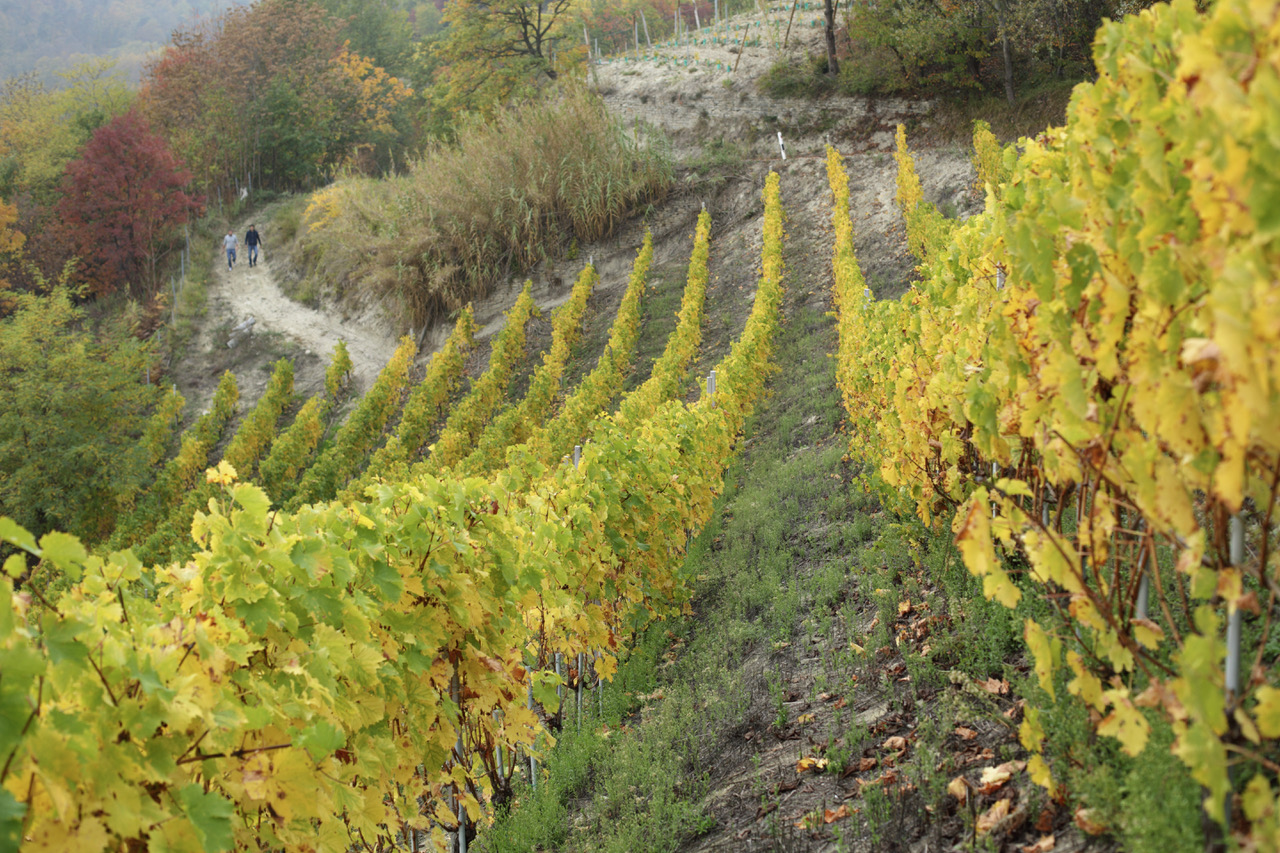
There is a number embedded in the name of this project – 499 – and it tells you almost everything you need to know. It is the altitude, in meters above sea level, at which the vineyards of Camo sit above the rolling hills of the Langhe. In the world of Piemontese wine, where the great names occupy lower, warmer ground, climbing to this elevation is something of a statement of intent.
The project belongs to two friends: Mario Andrion and Gabriele Saffirio. Mario is not a newcomer to wine, he has spent years as winemaker at the historic Castello di Verduno, one of Barolo’s most quietly distinguished estates. Gabriele, for his part, was born into a winemaking family and raised amongst the vines, later going on to work at Fratelli Brovia, another of the region’s finest. Together, in 2012, they turned their attention southeast of Barbaresco toward the foothills of the Ligurian Apennines, to a corner of the province of Cuneo that few producers had thought to look at twice. What they found there was limestone and sandy soils, a cooler microclimate and two old ideas worth reviving.
Those ideas are Freisa and Moscato – two varieties that have historically thrived at this altitude, and that the modern wine trade had largely chosen to forget. Their mission, from the outset, has been to make the purest possible expression of each: farming sustainably across six steep hectares of terraced hillside, with minimal intervention in the cellar and letting the fruit speak for itself.
Freisa, in particular, carries a fascinating story. Once one of Piemonte’s most widely planted grapes – making up a third to half of all vineyard hectares in the provinces of Asti and Alessandria as recently as the 1860s – it has been in slow retreat ever since. Its misfortune was its generosity: farmers loved it for being productive and disease resistant, and so it was routinely planted on poor sites and pushed to yield far more than it should. The result was underwhelming wine, and a variety that came to be associated with excess rather than quality. The 1990s and 2000s, with their appetite for richness and power, were not kind to it either.
Yet genetics tells an intriguing story. Studies have revealed that Freisa and Nebbiolo share a remarkably similar DNA profile – whether one gave rise to the other remains an open question, but their kinship shows in the vineyard and in the glass: the light colour, the tannic structure, the late ripening, the sensitivity to site. The key, it turns out, may simply be where and how the grape is grown. At altitude, on sandy soils, exactly the conditions Mario and Gabriele have sought out in Camo, Freisa reaches something closer to its full potential, haunting aromas of strawberry, cherry, violet and spice, an electric acidity, and a freshness that the lower-lying varieties of the region rarely match.
The timing, perhaps, is finally right. A generation of wine drinkers that craves energy and perfume over weight and extract is discovering what the locals of Piemonte have quietly appreciated all along. Azienda Agricola 499 is a patient argument on behalf of two forgotten grapes. Made high up, with conviction, by two friends who clearly know exactly what they are doing.