


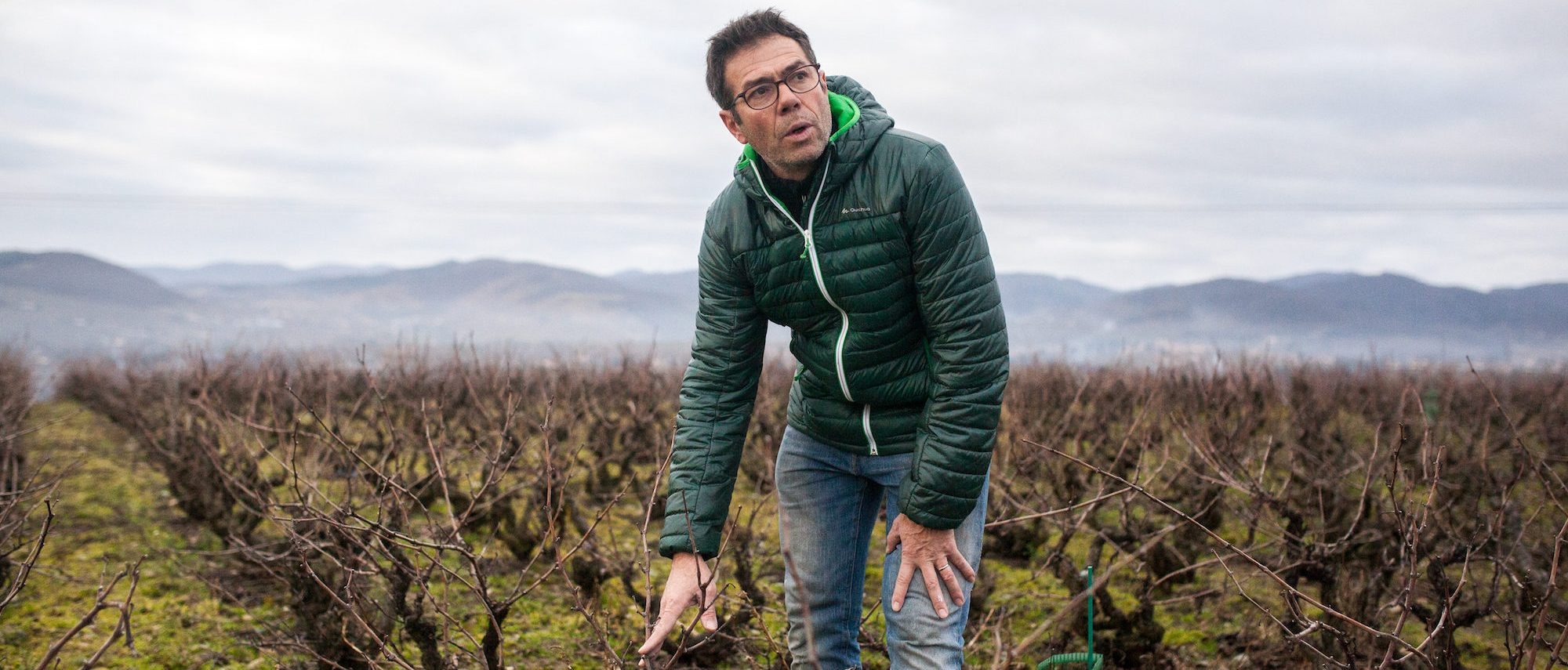
Jean-Marc Burgaud is based in Villié-Morgon, in the heart of the most celebrated of the crus. He began working here in 1989, when he had a hectare each in Beaujolais Villages, Régnié and Morgon. Three years later he got his first bit of Côte du Py. Now he’s got 17.5 hectares, with 4.5 ha in Beaujolais Villages, a hectare in Régnié, and the rest in Morgon, including a sizeable 8 hectares of Côte du Py.
Burgaud’s vineyards boast impressive stats, with an average vine age of 50+ years, all planted at high densities—up to 11,000 vines per hectare—and farmed with organic practices aimed at maintaining balanced yields and nurturing soil health. He judiciously applies treatments only when necessary, prioritising the preservation of the vineyard’s natural ecosystem.
In the cellar, his approach is tailored to the specific requirements of each cuvée, reflecting his dedication to understanding and translating the complexities of each terroir. The grapes undergo vinification with whole clusters, employing ambient yeasts in temperature-controlled vats. The wines are aged for up to 16 months in concrete tanks, with the exceptions of the Côte du Py, Javernières and James cuvées, which mature in carefully selected used barrels. Minimal sulfites are added only after the completion of malolactic fermentation.
Now, at the peak of his powers, Jean-Marc Burgaud is not only one of the most respected growers in the region, but one who is producing, each year, some of the greatest wines, combining rigorous structure, concentration of fruit, with an extraordinary poise, purity and finesse. Burgaud’s wines, whilst irresistible when released, have the capability to age and improve remarkably well, proving the high status and pedigree that exists in the region.
Ahead of the 2024 vintage, Morgon introduced a much more detailed geographical delineation: the six traditional climats were divided into around 60 individual lieux-dits. These more precise names are now used on wine labels to identify the specific vineyard site. In other words, the new lieu-dit names do not represent new vineyards, but rather a more precise identification of sites that were previously labelled under the broader climat names.